
Risk Management · 2025
In this section2 topics
Risk Management Policy & Plan
Policy & Plan Description
Pro Inside Public Company Limited recognizes the importance of risk management as a crucial mechanism for good corporate governance and a foundation for supporting business operations to achieve strategic objectives efficiently, and to foster stable and sustainable long-term growth. Appropriate risk management enables the company to make prudent decisions, considering both opportunities and potential impacts arising from changes in the business environment, technology, and relevant regulations.
The company has established an Enterprise Risk Management (ERM) system, covering the processes of identifying, assessing, and managing risks, as well as continuous monitoring and reporting of risk status. This ensures that risks that may affect the company's operations, performance, and reputation are managed appropriately, promptly, and in line with the organization's acceptable risk appetite.
Risk Management Standards and Guidelines
To ensure systematic risk management aligned with international best practices, the company has adopted the COSO Enterprise Risk Management Integrated Framework throughout the organization. This integrates risk management into business planning, routine operations, and strategic decision-making processes, ensuring that business operations are conducted within appropriate risk levels and in accordance with good corporate governance principles.
The company's risk management covers 6 key components, namely:
Objective Setting
Risk Identification
Risk Assessment
Risk Response Strategy Setting
Control Activities
Monitoring and Evaluation
The company mandates that executives and employees at all levels are responsible for identifying and assessing risks within their respective units, as well as establishing appropriate risk management measures. Risks that impact the achievement of the company's objectives must be identified in a timely manner, with opportunities and impacts assessed, risks managed considering appropriate costs and benefits, and continuous monitoring of results.
Risk Management Governance Structure
The Board of Directors is responsible for overseeing that the company has a comprehensive and effective risk management system. It assigns the Risk Management Committee the duty of setting direction, supervising, and monitoring risk management throughout the organization. The company has prepared a risk management manual to serve as a standard guideline for operations.
The Risk Working Group will regularly report risk results and status to the Risk Management Committee. In the event of significant incidents or risks affecting business operations, immediate reports will be made to senior management and the Chairman of the Risk Management Committee. High and very high-level risks, which may impact the company's business plans and strategies, will be reported to the Audit Committee and the Board of Directors quarterly for their acknowledgment.
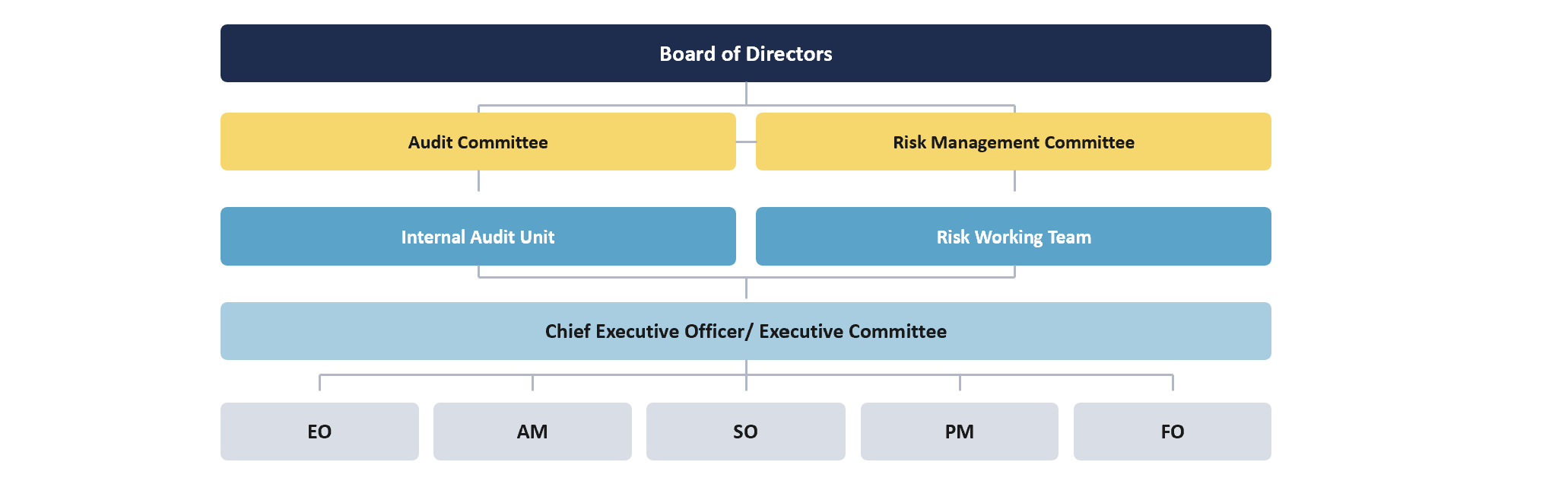
Roles and Responsibilities in Risk Management
Board of Directors and Audit Committee
is responsible for overseeing that the company has an appropriate risk management system, with effective reporting and monitoring. It receives quarterly reports on risk status and risk management outcomes from the Risk Management Committee.
Risk Management Committee
consists of 4 directors, with an independent director serving as chairman. Its duties include setting risk management policies and acceptable risk levels, proposing them to the Board of Directors for consideration, overseeing the development and implementation of the risk management framework, reviewing significant risk reports, and presenting an overview of risks, including the adequacy of internal control systems, to the Board of Directors, while also providing recommendations to relevant departments.
Risk Management Working Group
comprises representatives from the company's key departments. Its duties include supporting the operations of the Risk Management Committee by coordinating, collecting, analyzing, and assessing risks at the departmental and organizational levels, preparing risk status reports, monitoring the implementation of risk management plans, and promoting knowledge and understanding of risk management among employees throughout the organization.
Monitoring, Evaluation, and Continuous Improvement
The company promotes risk management as a shared responsibility among personnel at all levels, while supporting the use of information technology for integrated risk management. The Risk Management Committee will independently and systematically evaluate performance at least once a year, both at individual and committee levels, and report evaluation results, problems, obstacles, and improvement guidelines to the Board of Directors to continuously enhance the organization's risk management efficiency.
Risks to the Company's Business Operations
Risk Register
| Risk Name | Risk Characteristics | Consequences | Management Measures | Related Risk Factors |
|---|---|---|---|---|
| Risk from reliance on major clients | The company provides consulting, design, development, and installation of integrated information and communication technology (ICT) solutions. The majority of its work involves projects from government agencies and state enterprises, which must undergo government procurement processes. Consequently, the company's revenue is directly linked to the number and value of projects that government agencies and state enterprises open for bidding each year, both when the company is a direct contractor and when it undertakes work through private companies that are contractors with government agencies and state enterprises. Furthermore, the number and value of these projects depend on the budget allocated by the government in accordance with national policies or development plans at that time, such as the Digital Economy and Digital Government policies, Cloud First Policy, Smart City initiatives, and government data linkage. Should there be a change in policy or development plans that reduces the emphasis on investment in information technology, it could lead to a decrease in the number and value of projects open for bidding. | A reduction in the budget or the number of information technology projects may lead to a decrease in the company's opportunities to participate in project bidding, and could also impact the company's revenue, operating results, and future growth. Furthermore, a high reliance on major clients or existing customer groups may expose the company to risks concerning revenue continuity if such clients delay investments or alter their plans. | The company has established strategies for managing risks arising from reliance on major clients and government budgets. This is achieved by focusing on diversifying its client base to new government agencies and state enterprises, as well as expanding the proportion of work from private sector clients. This aims to reduce dependence on any single client or large client group. Concurrently, it develops revenue models from project work alongside recurring service revenue and after-sales services, which enhances long-term revenue stability. The company's main client base primarily consists of government agencies, public sector entities, and large organizations with stable financial standing and high liquidity. Consequently, the risk of default or contract cancellation is low compared to general business characteristics. Furthermore, the company places significant emphasis on closely managing its backlog. Projects currently in progress have revenue recognition periods spanning several years, which helps create certainty in future revenue and mitigates the impact of fluctuations in the number of new projects to be tendered each year. Concurrently, the company systematically monitors and manages projects in the bidding pipeline, including stages such as business opportunity analysis, technical readiness, documentation, and partner management, all aimed at increasing the chances of securing new work and ensuring revenue continuity. The company closely monitors government policies, budget plans, and investment trends in information technology to prepare for participation in future tenders, as well as to strengthen collaborations with business partners and technology owners. The aim is to enhance competitiveness, reduce the risk of technological obsolescence, and efficiently offer solutions that meet client needs. The company regularly monitors and reviews these risks within its enterprise-wide risk management framework. This involves considering the backlog status, pipeline progress, and revenue proportions from various client groups, with the objective of appropriately adjusting strategies and risk management measures in response to changes in the business environment. | 734 · Description: Reliance on large customers or few customers · Info category: STRATEGIC_RISK |
| Risk from reliance on personnel with skills, experience, and capabilities | The company's business involves providing comprehensive consulting, design, development, and installation services for information and communication technology (ICT) solutions. This necessitates personnel with extensive knowledge, specialized expertise, and practical experience across multiple stages. These stages encompass customer requirements analysis, architectural and solution design, technology and product selection, proposal submission and bidding, network and equipment installation, software development, system testing and performance monitoring, as well as maintenance services and cybersecurity protection. Furthermore, personnel are required to possess expertise and hold certifications from product owners. Such expertise is instrumental in fostering confidence among clients and product owners, and in elevating relationships as business partners. Consequently, the departure of personnel possessing specialized skills and experience could adversely affect operations, project management, and the company's future growth potential. | The loss of personnel possessing specialized knowledge and expertise may lead to project delays, a reduction in service efficiency, and could also adversely affect the ability to participate in bidding processes, the maintenance of work quality standards, customer confidence, and the continuity of relationships with business partners and technology owners. | The company has continuously prioritized the retention and development of its personnel. This includes considering appropriate compensation, providing training and skill development, supporting relevant certification examinations, and establishing career growth paths for employees. Furthermore, the company has developed a Succession Plan for key positions and has a process for recruiting and selecting replacement personnel for those who leave their positions, ensuring uninterrupted operations. In this regard, the company has adopted ISO 9001, ISO/IEC 20000-1, and ISO/IEC 27001 standards to ensure efficient, comprehensive, and continuous knowledge transfer within the organization. These measures help mitigate the risks associated with over-reliance on specialized personnel, encourage participation from employees at all levels in management, and enhance confidence in project execution and the provision of comprehensive ICT services to customers and stakeholders. | 738 · Description: Reliance on employees in key positions · Info category: OPERATIONAL_RISK · 739 · Description: Shortage or reliance on skilled workers · Info category: OPERATIONAL_RISK |
| Risks from changes in information technology and the diversity of services | The company operates a comprehensive information technology business, which involves the rapid development and changes in information technology, communication technology, and new innovations in both hardware and software to meet customer needs. This requires the company to continuously monitor and adapt to technological changes, as well as develop personnel with up-to-date knowledge and skills, and procure products that can fully satisfy customer requirements. | If the company is unable to adapt and develop its personnel to keep pace with technological changes, it may result in services becoming outdated or not meeting customer requirements, thereby leading to a loss of business opportunities and revenue. Furthermore, the complexity of project tasks and the diversity of services could lead to errors in project management, affecting work quality, customer satisfaction, and the company's reputation. Should these issues not be appropriately managed, they could impact the company's growth and competitiveness within the ICT industry. | The company possesses over 10 years of experience in the information and communication technology business and collaborates with market-leading partners in information technology and cybersecurity. This ensures continuous access to information and updates on new products and technologies. The company also prioritizes developing the knowledge and expertise of its personnel through training, overseas study tours, and knowledge exchange with partners. Furthermore, the company recruits new personnel with knowledge and skills in critical technologies such as Cloud and Cyber Security to meet customer demands and sustainably enhance its competitive capabilities. Additionally, the company continuously fosters collaborations with leading product owners, providing regular employee training and receiving support from product owners in co-designing approaches and methods for practical product implementation prior to customer presentation, thereby ensuring optimal efficiency in usage. | 732 · Description: Changes in technologies · Info category: STRATEGIC_RISK |
| Cyber threat risk | The company operates on information technology systems connected to the internet, which exposes it to risks from cyber threats such as data theft, computer virus infections, unauthorized system intrusions, or illicit access to data by external parties. Both company, customer, and partner data may be stolen or disseminated without authorization. Leaked information can cause both financial and reputational damage to the company, and may also lead to lawsuits or complaints from customers. | Should a cyber incident occur, critical company or customer data could be leaked or compromised, leading to financial and operational damages. The company might face lawsuits or complex legal disputes. Furthermore, the company's credibility and reputation among partners and customers could significantly diminish, impacting future business opportunities and potentially reducing the company's competitive edge. | The company has established a team of cybersecurity experts to regularly inspect and control information technology systems. Policies and enforcement measures have been implemented, such as Antivirus programs, defining authorized software for installation (Whitelist), prohibiting the use of unlicensed software, and continuous vulnerability analysis of the systems. The company provides training and education on cybersecurity to personnel at all levels to ensure strict adherence to security measures. Furthermore, the company mandates penetration testing of information technology systems at least once a year, and security measures are updated to keep pace with technology and international standards. | 744 · Description: Information security and cyber-attack · Info category: OPERATIONAL_RISK |
| Operational and Project Implementation Risks | The company's core business involves the sale and provision of ICT Solution projects, most of which require delivery according to milestones and contractual terms for each project. The company handles installations both through its own personnel and by engaging external service providers. The complexity of the projects and the number of involved parties may lead to operational management risks. If the company fails to adequately control product delivery, installation, or coordination with partners and subcontractors, it could result in project delays, failure to meet agreed standards, or errors in installation and after-sales services. All of these factors pose a risk to the company's operations. | If the company fails to manage projects according to standards and within the stipulated timeframe, significant financial and operational impacts may arise, such as penalties from clients, loss of opportunities to secure new projects, damage to the company's reputation and credibility, and a decline in relationships with business partners and clients. Furthermore, delays in each work phase may affect related projects or other projects within the company's pipeline, leading to increased overall project costs and reduced profit margins. These delays can stem from various factors, such as delays in material and equipment delivery, installation errors, or delays in coordination with contractors and partners. | To prevent and mitigate the impact of operational risks, the Company systematically plans and controls operations from the project's inception. This involves collaborative planning among the project management engineering team, subcontractors, and procurement and delivery partners to ensure that operations can proceed within the stipulated timeframe. Furthermore, the Company consistently monitors work progress and assesses risks throughout the project to allow for timely problem resolution and reduce the likelihood of impacts on project delivery. The Company has a practice of documenting and maintaining records of communication with clients in cases of force majeure, errors by the contracting party, or uncontrollable events, such as notifying the client in writing of the incident or circumstances within 15 days from the event's occurrence to request an extension of time or waiver of penalties. These documents also serve as evidence for future disputes. This systematic monitoring and coordination process enables the Company to manage projects continuously, preventing financial and operational risks, and maintaining the Company's credibility in the long term. | 746 · Description: Delays in the development of future projects · Info category: OPERATIONAL_RISK |
| Corruption Risk | As the company operates businesses involving high-value information technology projects, including participation in government tenders and contracting with large organizations, it faces risks of corruption from both within the organization and from external parties. Examples include bribery, conflicts of interest, or the inappropriate use of inside information. These risks can arise at every stage of a project, from bidding and procurement of equipment to project management and delivery of work to clients. | Corruption risks can severely impact a company's reputation, leading to a decrease in its credibility and potentially affecting relationships with customers, partners, and government agencies. Furthermore, corruption may also result in financial damage, legal penalties, or lawsuits, incurring remediation and problem management costs, which will consequently affect the company's operational performance and long-term growth. | To prevent corruption risks, the Company has clearly established good corporate governance policies and business ethics guidelines, along with implementing an effective internal control system, such as transparent internal audit processes, anti-corruption measures, fostering an organizational culture based on integrity, and educating employees on relevant codes of conduct and legal provisions. Furthermore, the Company provides channels for employees and external parties to safely report corruption tips, without fear of repercussions for the whistleblower. The Company also continuously monitors and assesses risks from the project's inception, to ensure that operations proceed according to plan and effectively reduce the likelihood of corruption-related issues. | 754 · Description: Corruption · Info category: OPERATIONAL_RISK |
| Financial liquidity risk | The company's business is project-based, requiring the company to procure equipment, goods, and various services for the installation of information technology systems for customers. Typically, the company must pay for goods and related expenses in advance, whereas payment from customers occurs upon completion of work according to the conditions and milestones specified in the contract. Furthermore, the company incurs recurring personnel expenses, which constitute a significant cost in its ongoing business operations. This type of cash flow structure may expose the company to liquidity risks if customer payments are delayed or if multiple projects simultaneously require working capital. | If the company is unable to manage its financial liquidity appropriately, it may result in a lack of working capital for daily operations, equipment procurement, or timely payment of various expenses. This could impact the ability to deliver work on schedule, the confidence of partners and customers, and may also increase financial costs due to the necessity of securing additional funding sources. Furthermore, liquidity risk may affect the ability to expand the business and undertake new projects in the future, which could consequently impact the company's long-term performance and growth. | To manage and mitigate financial liquidity risks, the Company has established a stringent cash management policy. This involves systematic financial planning and cash flow management to ensure sufficient liquidity for operations and investments in various projects. The Company regularly monitors and assesses its financial status to appropriately adjust financial plans in response to changing circumstances. Furthermore, prior to considering each project, the Company meticulously evaluates payment terms, the suitability of work phases, and potential working capital requirements. This also includes establishing guidelines for monitoring and managing overdue debts from customers, thereby enhancing the Company's long-term liquidity stability and financial security. | 1724 · Description: Liquidity risk · Info category: FINANCIAL_RISK |
| Risk from foreign currency exchange rate fluctuations | The company operates by providing information technology project services, with the responsibility of procuring, installing, and delivering system-related equipment to customers. In some projects, the company needs to procure and import goods from foreign partners. Payments for these goods to foreign partners are made in foreign currency, while all of the company's revenue comes from project owners in Thailand, who make payments in Thai Baht.
| Exchange rate fluctuations may significantly increase the cost of imported goods and equipment, which could impact the project's gross profit margin and affect the company's overall operational performance, especially in projects with long operational periods or those with fixed sales prices agreed upon from the outset.
| The company prioritizes the management of foreign exchange risks. It mandates the accounting department and relevant departments to closely monitor news, trends, and changes in foreign exchange rates, and to regularly report this information to management and relevant units. This is used for procurement planning, project cost estimation, and overall cost management.
| 764 · Description: Fluctuation in exchange rates, interest rates, or the inflation rate · Info category: FINANCIAL_RISK |
| Risk of Receivables and Unbilled Revenue | The company's revenue primarily derives from contracting projects for the installation of information technology systems, physical security systems, and maintenance services, which are characterized by long-term contracts. The company is required to procure goods and provide services to customers first, utilizing its own capital. Revenue is recognized based on the percentage of completion of the work or in proportion to the costs incurred. However, such revenue recognition may not align with the billing schedule for customers, which typically involves installment payments as per contractual terms. This results in unbilled revenue or contract assets appearing on the statement of financial position.
| If debtors make late payments or fail to comply with the terms stipulated in the contract, this may result in the company holding accounts receivable and uncollected revenue for a longer period, which could impact operating cash flow and increase the burden of managing the company's working capital.
| The Company has established systematic policies and processes for managing debtors and unbilled revenue. This includes verifying customer creditworthiness and payment history before considering credit limits or entering into contracts for each project, as well as considering payment terms appropriate to the nature of the work and the customer's risk level.
| 767 · Other name: Delay in debt payment · Description: Other · Info category: FINANCIAL_RISK |