
MD&A · 2025
In this section4 topics
Overview of Operations
Overview — Introduction
Pro Inside Public Company Limited (“the Company”) operates in the business of providing integrated design, development, installation, and maintenance services for Information Technology systems, known as “ICT Solutions.” This is categorized into Physical Security Solutions, ICT Application Solutions, and IT Integration Services, covering the procurement and distribution of products and equipment related to information technology systems.
Economic and Industry Conditions Impacting Operations
In 2025, the Thai economy demonstrated a gradual recovery, accelerating significantly towards the end of the year. This resulted in a Year-over-Year (YoY) expansion in Gross Domestic Product (GDP). The primary growth drivers were government budget disbursements and economic stimulus policies, particularly the implementation of the Digital Government initiative. This policy positively impacted the continuity of public sector projects and generated new bidding opportunities for the Company throughout the year. Additionally, the robust recovery of the electronics export sector encouraged private enterprises to resume investments in Smart Security and IT infrastructure.
Regarding monetary policy, the easing of the policy interest rate by the Monetary Policy Committee (MPC) during the year helped sustain business recovery and alleviate financial costs. This favorable environment benefited the Company's capital structure in managing large-scale projects that require substantial working capital. Throughout 2025, the Company strictly managed its financial structure, aligning borrowing costs with operating cash flows, and effectively planned debt repayments to mitigate long-term interest rate risks.
The Information and Communication Technology (ICT) industry experienced outstanding growth throughout the year, fueled by the government’s "Cloud First" policy and tangible advancements in digital infrastructure and Smart City projects. However, market competition remained intense due to the entry of global service providers in the Cloud, AI, and Big Data sectors. To address these challenges, the Company strategically focused on providing comprehensive System Integration (SI) solutions and increasing the proportion of revenue from Maintenance Service Agreements (MA), thereby generating a stable stream of recurring income.
During the year, the Company prioritized delivering cost-effective and agile solutions to meet customer demands, such as AI-driven Security, Cloud-based Data Management, and IT Outsourcing services designed to optimize operational efficiency and reduce costs. Furthermore, the Company expanded collaborations with global technology partners to enhance service quality and competitiveness.
In terms of external factors, global trade policy fluctuations and more defined U.S. import tax measures had a limited direct impact on the Company, as its core revenue is generated from domestic project deliveries. Nevertheless, the Company closely monitored potential indirect impacts, particularly foreign exchange volatility affecting the import costs of technology equipment and price adjustments within the global supply chain. The Company actively employed hedging instruments and stringent forward cost management strategies to mitigate these risks.
Through comprehensive risk management and proactive strategic adjustments throughout 2025, the Company is confident in its capability to navigate challenges, capitalize on business opportunities, and maintain sustainable and continuous growth in its operational performance.
Overview of Operations
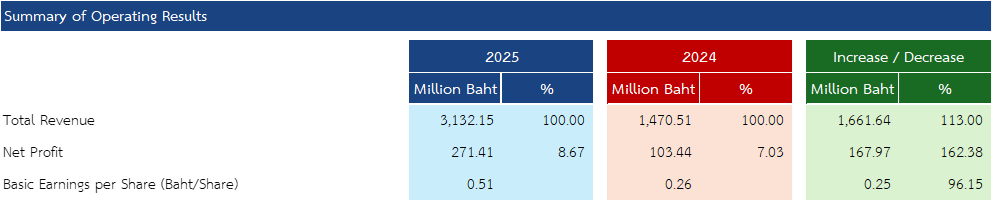
The overview of revenue from operations for the year 2025 was THB 3,132.15 million, an increase of THB 1,661.64 million or 113.00% from the year 2024. This was a result of the confidence in the Company's operational capabilities and performance from both the public and private sectors, enabling the Company to secure an increased number of projects from clients, including large-scale government projects with higher contract values compared to the previous year. Consequently, the net profit for 2025 was reported at THB 271.41 million, an increase of THB 167.97 million or 162.38% from the net profit of THB 103.44 million in 2024.
Operating Results & Financial Condition
Operating Results & Profitability
Revenue from System Integration Services
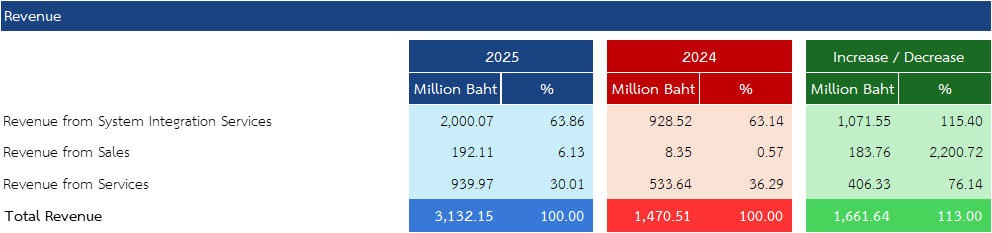
The overview of revenue from system integration services for the year 2025 was THB 2,000.07 million, an increase of THB 1,071.55 million or 115.40% from 2024. This was due to the Company securing an increased number of projects compared to the previous year. Additionally, during 2025, the Company secured large-scale government projects. The key projects for the year 2025 are as follows:
Project for the procurement, development, installation, and maintenance of Enterprise Resource Planning (ERP) systems
Project for the installation of the Traffic Technology and Safety Control Center for the Bangkok Metropolitan Administration (BMA)
Project for National Health Cloud Development Project, Activity 1: Development of the Health Information Exchange Management System
Revenue from Sales
For the year 2025, the Company reported total sales revenue of THB 192.11 million, achieving an exponential growth of 2,200.72%, or an increase of THB 183.76 million, compared to THB 8.35 million in 2024. This remarkable surge was primarily driven by high-value procurement orders from key clients for advanced technological equipment. Notable deliveries included high-performance Dense Wavelength Division Multiplexing (DWDM) technology and advanced routers, which were strategically procured to support and enhance the clients' operational infrastructure. The significant transaction driving this revenue growth in 2025 was the procurement and delivery of equipment under a telecommunication network installation project.
Revenue from Services
The overview of service revenue for the year 2025 was THB 939.97 million, an increase of THB 406.33 million or 76.14% from 2024. This was due to an increase in the number of maintenance project contracts from government agencies, as well as the continuation of service contracts from 2024. The key projects for the year 2025 are as follows:
Contract for the maintenance of Core Business Software Packages and related system integration.
Contract for service of the Sustainable Digital Community Ecosystem Development Project, Activity 1: Provision of Public Internet Centers (Digital Community Centers) totaling 1,722 centers; Group 4: Equipment leasing and personnel provision for 412 Digital Community Centers.
Contract for the maintenance of CCTV systems at Suvarnabhumi Airport, Don Mueang Airport, Chiang Mai Airport, Hat Yai Airport, Phuket Airport, and Mae Fah Luang Chiang Rai Airport.
Lease agreement for the vehicle operation monitoring and tracking system (GPS) with installation.
Revenue Backlog
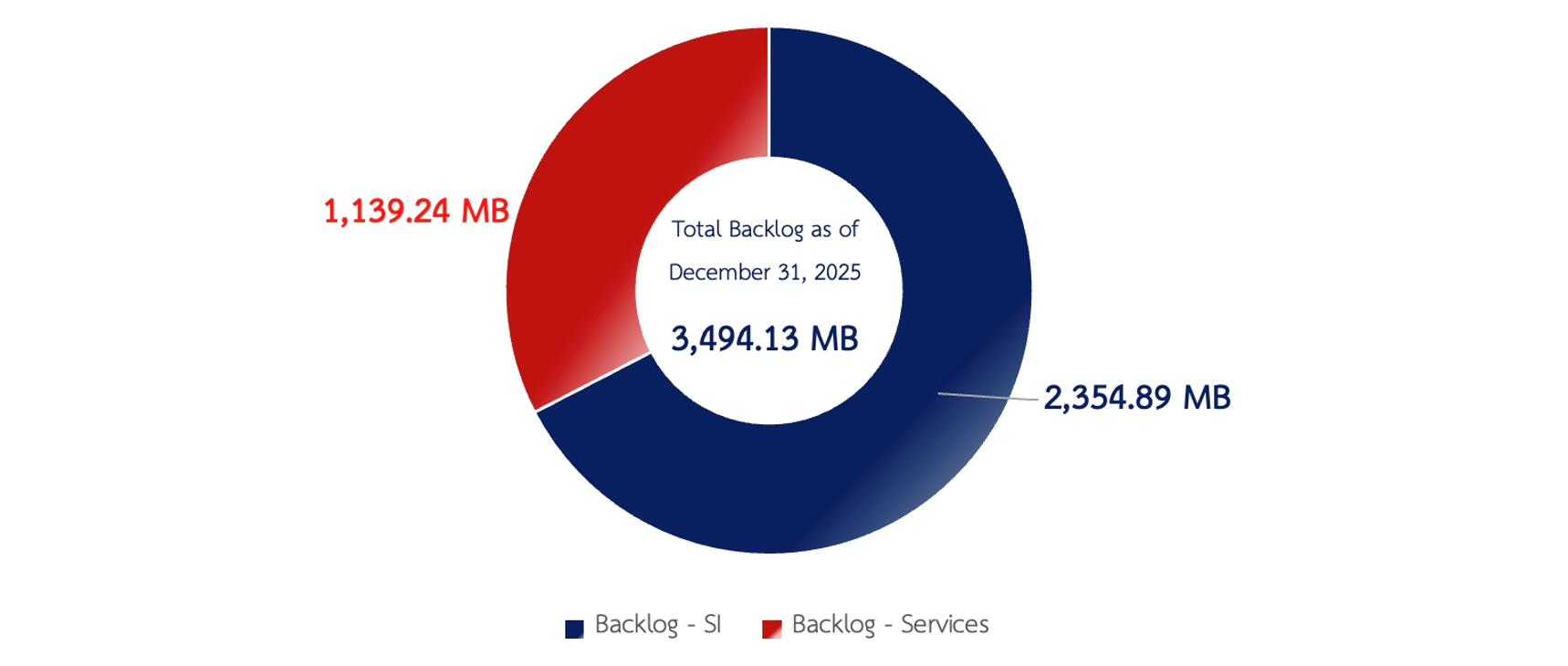
As of 31 December 2025, the Company has projects with a total backlog of THB 3,494.13 million. This serves as a testament to the stability of the revenue base that will be gradually recognized in 2026 and demonstrates the continuous trust that government agencies and partners have in the Company’s information technology solutions. The revenue backlog can be categorized by revenue group in the following proportions:
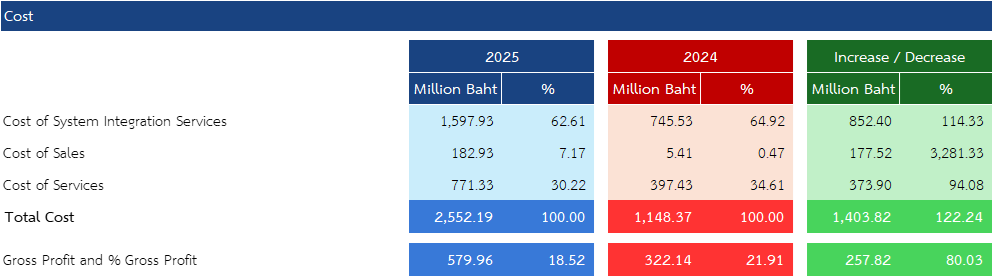
The overview of total costs for the year 2025 was THB 2,552.19 million, an increase of THB 1,403.82 million or 122.24% compared to 2024, which had total costs of THB 1,148.37 million. Meanwhile, the overall gross profit margin decreased from 21.91% in 2024 to 18.52% in 2025. This was a result of:
Cost of System Integration Services: Increased by THB 852.40 million or 114.33% from 2024, which was in the same direction as the increase in revenue from system integration services, due to an increased number of projects, including large-scale government projects. However, the majority of the acquired large-scale projects had a high proportion of equipment and installation costs, this resulted in a lower gross profit margin.
Cost of Sales: increased by THB 177.52 million compared to 2024, representing a significant growth of 3,281.33%. This surge is aligned with the increase in sales revenue, primarily driven by the procurement and delivery of high-value technological equipment for customer projects. However, as the equipment involves highly advanced, complex, and specialized technologies, the procurement costs remained substantial. Consequently, this resulted in a relatively narrow gross profit margin.
Cost of Services: Increased by THB 373.90 million or 94.08% from 2024, which increased in a higher proportion than the increase in revenue from services. The cause arose from the expansion of the scope of maintenance and information technology support services in various government agencies, resulting in personnel costs and operating expenses increasing in a higher proportion than revenue growth.
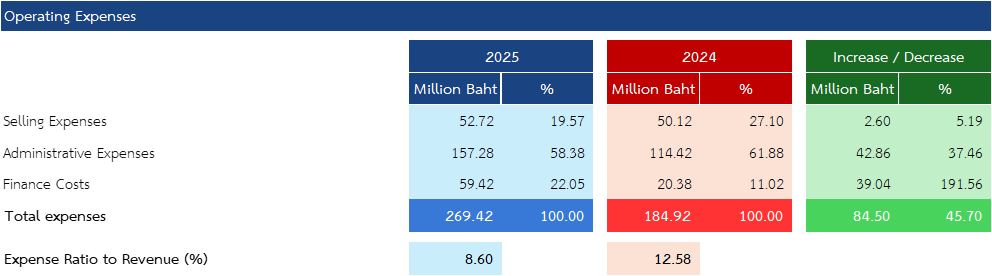
The overview of operating expenses for the full year 2025 was THB 269.42 million, an increase of THB 84.50 million or 45.70%. The primary causes were as follows:
Administrative Expenses: Increased by THB 42.86 million or 37.46% compared to 2024. The primary cause was an increase in employee-related expenses resulting from the Company's continuous growth, which led to increased hiring, as well as an increase in management expenses to support the Company's operations and ensure their smooth continuation. In addition, during 2025, the Company recorded an allowance for expected credit losses for receivables to ensure that the value of receivables accurately reflects the realizable value over time.
Finance Costs: Increased by THB 39.04 million or 191.56% compared to 2024. This was primarily due to increased borrowing to support working capital requirements and facilitate the operations of large-scale projects secured during the second half of the year 2025.
For the full year of 2025, the total expense-to-revenue ratio stood at 8.60%, a decrease from 12.58% in 2024. This demonstrates improved efficiency in overall expense management relative to total revenue growth.
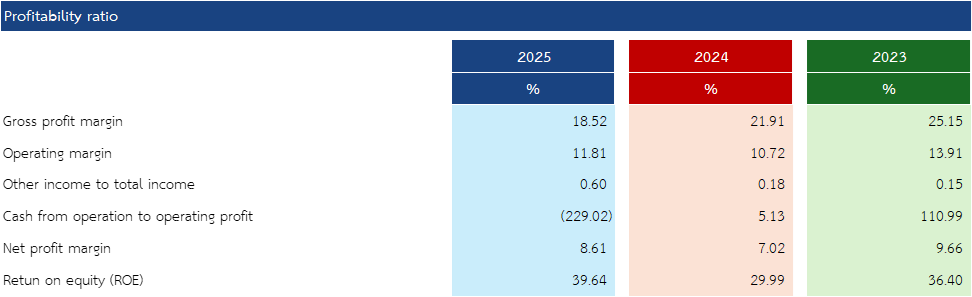
In 2025, the Company demonstrated robust and significantly improved profitability. Although the gross profit margin slightly decreased to 18.52% from 21.91% in 2024 due to a higher proportion of revenue from large-scale projects, the Company successfully leveraged economies of scale and highly efficient expense management. Consequently, the operating margin and net profit margin improved to 11.81% and 8.61%, respectively. Furthermore, the Company generated an outstanding return on equity (ROE) of 39.64%, reflecting its strong capability to translate top-line growth into substantial bottom-line returns for shareholders.
However, the decline in the Cash from operation to operating profit to -229.02% is a temporary timing effect inherent to the system integration business during a high-growth phase. The Company was required to allocate working capital for upfront equipment procurement and project initiation, leading to a temporary increase in contract assets and accounts receivable. As the Company achieves project milestones and collects payments according to contractual terms, operating cash flows will normalize and align with the recognized net profit in subsequent periods.
Liquidity & Capital Adequacy
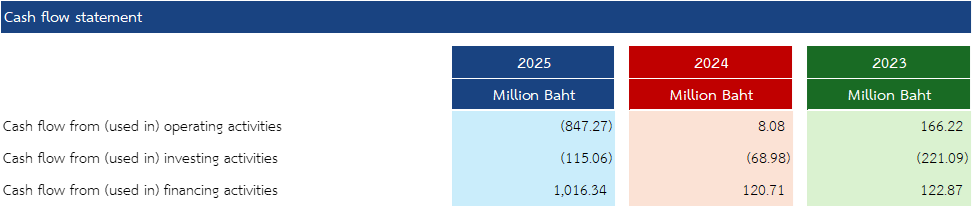
For the year ended 31 December 2025, the Company reported ending cash and cash equivalents of THB 192.27 million. Net cash used in operating activities amounted to THB 847.27 million, a shift from the net cash generated of THB 8.08 million in 2024. This cash outflow does not indicate operational constraints but rather reflects the exponential top-line growth in the system integration business. Consequently, the Company required substantial working capital for upfront equipment procurement and project execution, as evidenced by an increase in accounts receivable of THB 884.19 million, contract assets of THB 216.97 million, and inventories of THB 142.20 million.
Regarding investing activities, net cash used was THB 115.06 million, compared to THB 68.98 million in 2024. This increase was primarily driven by a THB 96.45 million rise in restricted bank deposits, which the Company utilized as collateral for bidding and delivering large-scale projects. However, the Company demonstrated exceptional financing capabilities, generating net cash from financing activities of THB 1,016.34 million, a significant increase from THB 120.71 million in the preceding year. This robust funding was mainly fueled by THB 406.90 million in proceeds from the issuance of equity instruments, coupled with the net drawdown of short-term loans from financial institutions to secure liquidity for the expanding project portfolio.
The overall cash flow profile in 2025 illustrates a proactive financial management strategy. Despite the negative operating cash flow inherent to the current high-growth phase, the Company maintains robust liquidity and an optimal capital structure. This is firmly supported by strong investor confidence, as reflected in the successful capital increase, and sufficient credit facility backing from financial institutions. These factors ensure the Company is well-equipped with adequate capital to continuously fund, execute, and deliver future large-scale projects seamlessly.
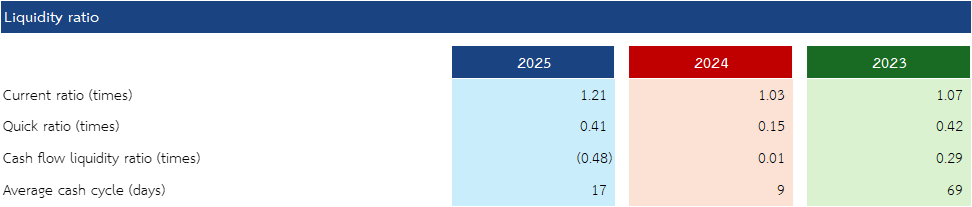
In 2025, the Company demonstrated a significantly stronger and more resilient liquidity position. The current ratio improved to 1.21 times from 1.03 times in 2024, alongside a notable increase in the quick ratio to 0.41 times from 0.15 times in the previous year. This enhancement is primarily driven by highly efficient capital structure management through successful fundraising and the procurement of optimal short-term credit facilities, which bolstered current assets to adequately cover short-term obligations. Furthermore, the Company maintained excellent working capital efficiency, recording a cash cycle of 17 days. Although a slight increase from 9 days in 2024, this still reflects a rapid cash conversion cycle perfectly aligned with industry standards.
However, the decline in the cash flow liquidity ratio to -0.48 times, down from 0.01 times in 2024, represents a temporary effect stemming from proactive management during a high-growth phase. Operating cash flows were strategically utilized as working capital for upfront equipment procurement and the initiation of large-scale projects. When considering this alongside the rapid cash cycle and the significantly expanded equity base, the Company possesses robust capital adequacy to sustainably support its growth trajectory without encountering any short-term liquidity risks.
Asset Management Capability
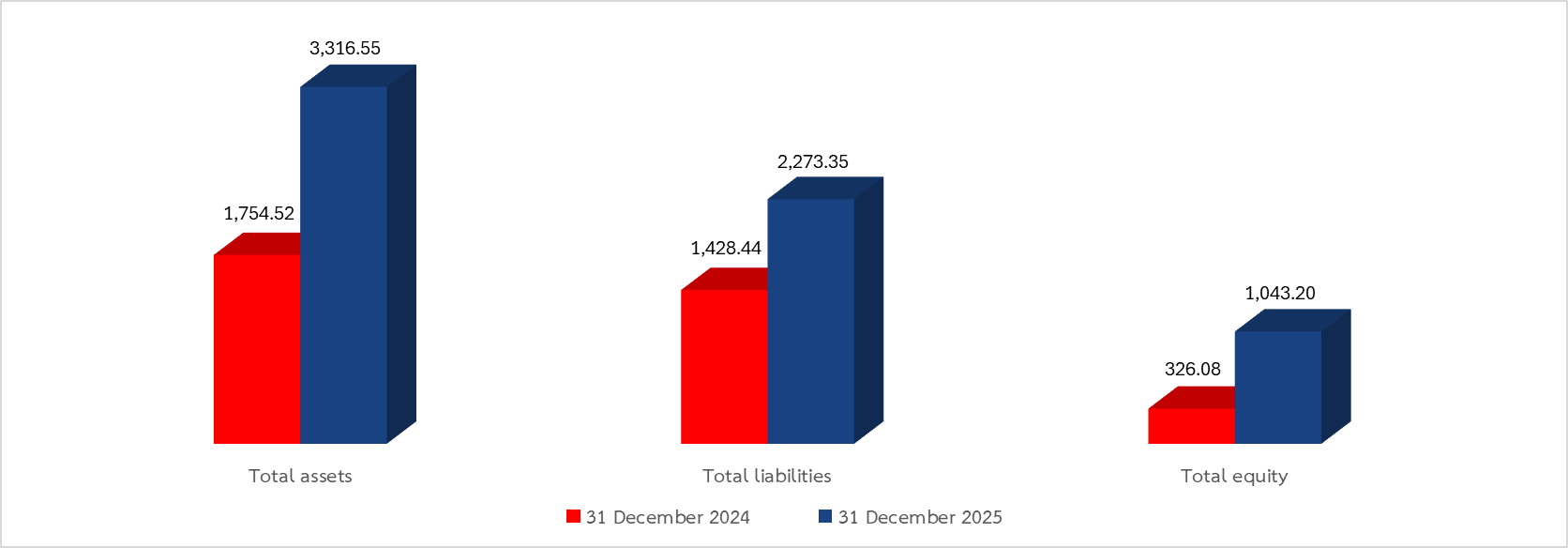
Total assets as of 31 December 2025, amounted to THB 3,316.55 million, an increase of THB 1,562.03 million or 89.03% from the end of 2024. The primary factors contributing to this growth were trade and other receivables, which increased by THB 862.53 million due to billing for large-scale projects delivered during 2025, and contract assets, which increased by THB 215.80 million resulting from revenue recognition for work delivered but not yet billed. Additionally, inventories increased by THB 142.20 million due to work-in-process and equipment procurement for ongoing and upcoming projects. Advance payments for project costs also rose by THB 99.95million for equipment and services related to projects commencing in 2026. Furthermore, restricted bank deposits increased by THB 96.45 million to serve as collateral for issuing letters of guarantee for new project bids and operations. Finally, the Company has VAT refundable currently under the audit and refund process by the Revenue Department totaling THB 52.08 million.
However, property, plant, and equipment decreased by THB 53.40 million due to depreciation of project equipment utilized during 2025.
Total liabilities as of 31 December 2025, stood at THB 2,273.35 million, an increase of THB 844.91 million or 59.15% from the end of 2024. The main causes were short-term loans from financial institutions, which increased by THB 714.10 million to support working capital for ongoing projects, and trade and other payables, which increased by THB 171.67 million due to the procurement of equipment and services for large-scale projects. Meanwhile, contract liabilities and long-term liabilities showed only minor changes consistent with normal business operations.
Total shareholders' equity as of 31 December 2025, amounted to THB 1,043.20 million, an increase of THB 717.12 million or 219.92% from the end of 2024. The primary drivers were the capital increase from the Initial Public Offering (IPO) of 140.00 million ordinary shares at a price of THB 3 per share, executed in Q1/2025, and the continuous increase in retained earnings derived from operating results during 2025.
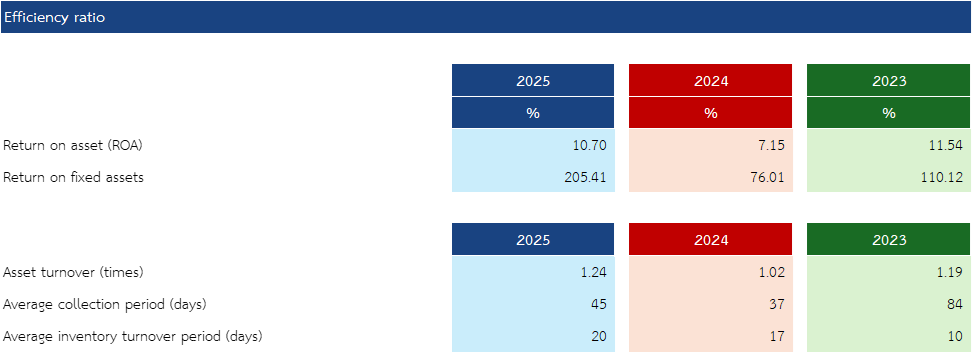
In 2025, the Company demonstrated exceptional capability in managing its assets to efficiently generate revenue and profitability. The total asset turnover ratio increased to 1.24 times from 1.02 times in 2024, which subsequently drove the Return on assets (ROA) up to 10.70% from 7.15% in the previous year. Most notably, the return on fixed assets (ROFA) achieved an exponential leap to 205.41%, compared to 76.01% in 2024. This remarkable surge underscores the success of the Company's Asset-Light business model, which relies heavily on technological expertise and system integration capabilities rather than intensive capital expenditures, allowing the Company to generate massive top-line growth from its existing asset base.
Regarding working capital management, the Company maintained stringent financial discipline. Although the average collection period and average inventory turnover period slightly increased to 45 days and 20 days, respectively (compared to 37 days and 17 days in 2024), these metrics remain exceptionally healthy and well within standard industry benchmarks. This slight variation is a direct result of the Company's strategic expansion into large-scale projects with milestone-based payment terms, coupled with proactive forward-purchasing of inventory to mitigate supply chain disruption risks. These strategic actions ensure the Company's readiness to continuously execute and deliver major projects on schedule.
Debt Obligations & Off-Balance-Sheet Management

In 2025, the Company's capital structure strengthened and stabilized significantly, as evidenced by a substantial decrease in the debt-to-equity ratio to 2.18 times from 4.38 times in 2024. This remarkable improvement was primarily driven by successful fundraising activities and a surge in unappropriated retained earnings, which robustly expanded the shareholders' equity base. Although the Company utilized additional short-term borrowings as working capital to support the execution of large-scale projects during the year, the exponential growth in equity outpaced the increase in debt. This effectively mitigated the overall financial risk and created ample headroom for future financing opportunities to fully support upcoming project bidding plans.
Regarding debt-servicing capability, the Interest Coverage Ratio decreased to 7.57 times from 10.87 times in 2024. This decline was a direct result of higher financial costs associated with increased short-term borrowing to fund project expansions. Nevertheless, a ratio of 7.57 times remains highly comfortable, indicating that the Company's operating profit is robust and more than sufficient to cover interest expenses. Concurrently, the Debt Service Coverage Ratio (DSCR) improved to 0.69 times from 0.44 times in the preceding year. This enhancement underscores the Company's efficient cash flow and debt structure management, ensuring a stable capacity to meet both principal and interest obligations in tandem with business expansion.
Debt Securities with Financial Ratio Requirements
Debt Securities with Financial Ratio Requirements Issued?
No
Factors That May Affect Financial Condition
Factors or Incidents That May Materially Affect Financial Condition
The Company operates as a comprehensive information technology service provider, covering consulting, design, distribution, turnkey implementation, and maintenance. Amidst the dynamics of rapidly changing technology and a challenging geopolitical economic environment, the Company places great emphasis on risk management and proactive planning. To maintain a strong financial position and build upon the significant growth in operating performance achieved recently, the Management has been closely monitoring and evaluating external factors, particularly the volatility of the global supply chain and economic costs. This is to adjust operational strategies, ensuring that the Company can deliver projects with high quality, strictly manage costs, and generate sustainable returns for shareholders. The factors that may significantly affect the Company's financial position or future operations can be summarized as follows: 1. The trend of digital transformation amidst budget challenges Both public and private sector organizations continue to require investments in IT infrastructure and cybersecurity systems, which aligns with the Company's expertise and presents an opportunity to expand the value of projects on hand. However, economic uncertainty may cause some client groups to delay investment decisions, reduce budgets, or cause delays in budget disbursement by government agencies. These factors may affect the timing of the Company's future revenue recognition. Therefore, the Company focuses on risk diversification by expanding its customer base across various industries to capitalize on business opportunities, rather than relying primarily on government investments. 2. Adaptation and technological upgrading to support new innovations As a comprehensive IT service provider, rapid technological changes such as Artificial Intelligence (AI), Enterprise Cloud Computing, and Advanced Cybersecurity are both significant challenges and opportunities. The Company must continuously "upgrade its technology" in terms of offering modern solutions to clients and upgrading operational tools to enhance efficiency. If the Company fails to adapt or provide technologies that meet changing market demands in a timely manner, its competitiveness may be affected. Nevertheless, the strong growth in the distribution and turnkey implementation business group reflects the Company's capability to deliver technologies that effectively meet customer needs. To maintain this standard, the Company has strategic plans to closely expand cooperation with business partners and support internal studies of new innovations to develop value-added services. This will be a positive factor supporting revenue growth and maintaining profit margins in the long term. 3. The impact of geopolitical issues on the IT equipment supply chain Under the uncertainty of the global economy, including the escalating geopolitical conflicts between the United States, Israel, and Iran since late February 2026, and the closure of the Strait of Hormuz, the global supply chain has been impacted, particularly in the transportation and production capacity of electronics and semiconductors. This factor may directly affect the distribution and turnkey implementation business in terms of longer delivery lead times for goods and equipment from suppliers, as well as increased logistics costs. To cope with this risk, the Management has intensified its strict inventory management and closely negotiated advance purchasing plans with vendor partners to ensure that project deliveries meet scheduled timelines. 4. Volatility of energy costs and the impact on financial costs The conflict in the Middle East has significantly driven up crude oil prices in the global market. This factor not only increases overall operating costs for many companies reliant on energy consumption, but also contributes to inflationary pressures and prompts central banks to maintain strict monetary policies. This subsequently impacts the financial costs of the Company, which utilizes working capital to execute large-scale projects. Therefore, the Company has a policy of prudent liquidity management, keeping the debt-to-equity ratio at an appropriate level, and managing cash flow in alignment with business expansion plans. 5. Competition in attracting and retaining IT talent The distribution and turnkey implementation business is primarily driven by human resources. Given the competitive landscape in the industry, there is a shortage of specialized IT personnel, which may affect the Company's capacity to take on future projects. Therefore, the Company prioritizes human resource management by implementing a competitive compensation policy, continuously developing employee potential through training and workshops, and creating a positive working environment to retain the key personnel who drive the Company's operating performance.